Independent directory — we compare Charleston water damage companies; we don't do the work ourselves.
Quick answer
Searching for basement flood cleanup in Charleston? Here's the honest local truth: most Charleston-area homes don't have basements — they sit on vented crawl spaces over sandy Lowcountry soil with a high water table, so the "flooded basement" problem happens under the house instead of in it. The cleanup is the same intent and mostly the same process — extraction, drying, sanitizing, prevention — and it typically costs $1,500–$6,000, with vapor barrier or encapsulation as a follow-on. If you do have one of the metro's rare basements, everything below applies to it too.
Tell us what happened — we'll connect you with Charleston-area restoration help right away. Free, no obligation.
Call (803) 910-601824/7 — speak with a local specialist now.
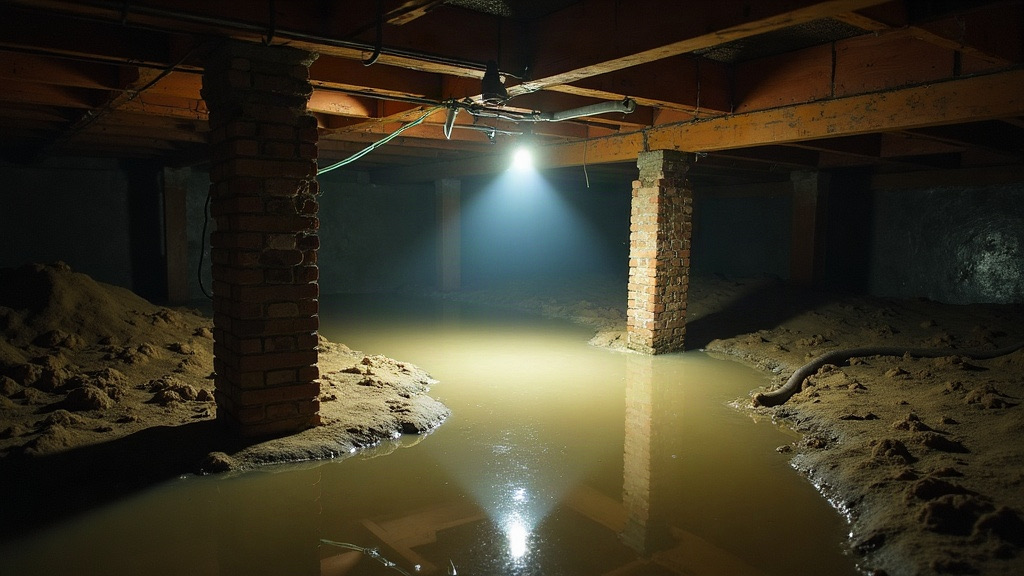
Basements are rare in the Lowcountry for a simple reason: the water table won't let you dig one. Much of the Charleston metro sits only a few feet above sea level, and below a shallow layer of soil you're into groundwater — a basement here would be a boat. Instead, the housing stock sits on vented crawl spaces: older homes downtown and in West Ashley often on raised brick piers, post-war suburbs on block-perimeter crawl spaces.
So when Charleston homeowners search for "basement flood cleanup," the house underneath them is telling the same story a basement would: standing water where it shouldn't be, musty smells, and a mold clock that started ticking the moment the water arrived. The job is the same job — it just happens in three feet of headroom instead of eight.
The work mirrors basement flood cleanup, adapted for confined space. Extraction comes first — pumps and portable extractors pull standing water. Debris and ruined material — fallen insulation, old vapor barrier, anything the water carried in — comes out. Drying follows with air movers and dehumidifiers sized for the space, run until moisture readings in the wood say it's done, not until it looks done. If the water was gray or black, antimicrobial treatment of the soil surface, piers and joists is part of the scope.
Then the honest conversation: prevention. A crawl space that flooded once will flood again unless something changes — a proper 12–20 mil vapor barrier, sealed crawl-space encapsulation with a dehumidifier, drainage correction, or at minimum clean downspout routing. Companies that extract the water and skip this conversation are scheduling their own return visit. Disaster Plus, among the locals, lists crawl space water removal as an explicit service line — it's a standard Charleston scope, not a specialty.
Most crawl-space floods are discovered late, from inside the house. Watch for: a musty smell strongest at floor level or when the HVAC starts; cupping or buckling hardwood; doors that suddenly stick; a jump in indoor humidity; and allergy symptoms that ease when you leave home for a few days. If you see any of these after a heavy rain week, the crawl space needs eyes on it — yours with a flashlight at the access hatch, or a professional moisture inspection.
Crawl-space water removal and drying typically runs $1,500–$6,000, driven by standing-water volume, contamination category, and how much insulation and barrier material has to come out. Vapor barrier replacement adds roughly $1,500–$3,000; full encapsulation with a dehumidifier runs $5,000–$12,000 depending on footprint — expensive, but it's the line item that ends the cycle. If the water came from a sewer backup, the sewage scope ($5,000–$15,000+) applies instead. See the full Charleston price breakdown.
If you're in one of the metro's few basement homes — they exist, mostly in later construction on higher ground toward Summerville and Goose Creek — the playbook is the standard national one: extract, remove wet porous material, dry with dehumidification, sanitize if the water wasn't clean, and figure out whether the water came from walls/floor joints (drainage) or plumbing (repair). Slab-on-grade homes, the other common Charleston build, skip the under-house problem entirely but take flood water straight into living space — that cleanup is covered on our emergency water removal page.
Almost none do. The shallow coastal water table makes basements impractical, so most Charleston-area homes sit on vented crawl spaces (older homes often on raised piers). A handful of newer homes on higher ground toward Summerville and Goose Creek have basements — the cleanup process there follows the standard national approach.
Extraction, drying and sanitizing typically run $1,500–$6,000. Vapor barrier replacement adds $1,500–$3,000; full encapsulation with dehumidifier runs $5,000–$12,000. Sewage-contaminated crawl spaces cost more ($5,000–$15,000+) because of the demolition and disinfection scope.
Yes. Stack effect pulls crawl-space air up into your living space, so whatever grows under the house ends up in the house. Within 24–48 hours in Charleston's climate, wet materials under the house begin supporting mold; within a season, floor joists and subfloor take real damage.
A vapor barrier stops ground moisture evaporation, not bulk water. If water physically flows or rises into the crawl space, you need drainage correction, sump pumping, or full encapsulation — the barrier is the finishing layer, not the fix.
A sudden plumbing leak under the house is typically covered like any other sudden water loss. Water that entered from outside — rain, tides, rising groundwater — is flood damage, covered only by a separate flood policy. Chronic seepage is usually excluded as maintenance.
Speak with a local specialist 24/7 — we'll connect you with Charleston-area restoration help. Free, no obligation.