Independent directory — we compare Charleston water damage companies; we don't do the work ourselves.
Quick answer
With water actively in your home: (1) stop the source at the main shut-off if it's plumbing, (2) cut power to wet areas if you can do it from a dry spot, (3) call a 24/7 restoration company — in Charleston, Seaside Restoration, Disaster Plus, RestoPros, PuroClean, Paul Davis, Patriot Restoration and SERVPRO all advertise round-the-clock dispatch, with typical on-site times of 1–2 hours. Emergency extraction and drying in Charleston typically costs $1,200–$5,000; starting within hours is what keeps it there instead of becoming a mold job.
Tell us what happened — we'll connect you with Charleston-area restoration help right away. Free, no obligation.
Call (803) 910-601824/7 — speak with a local specialist now.
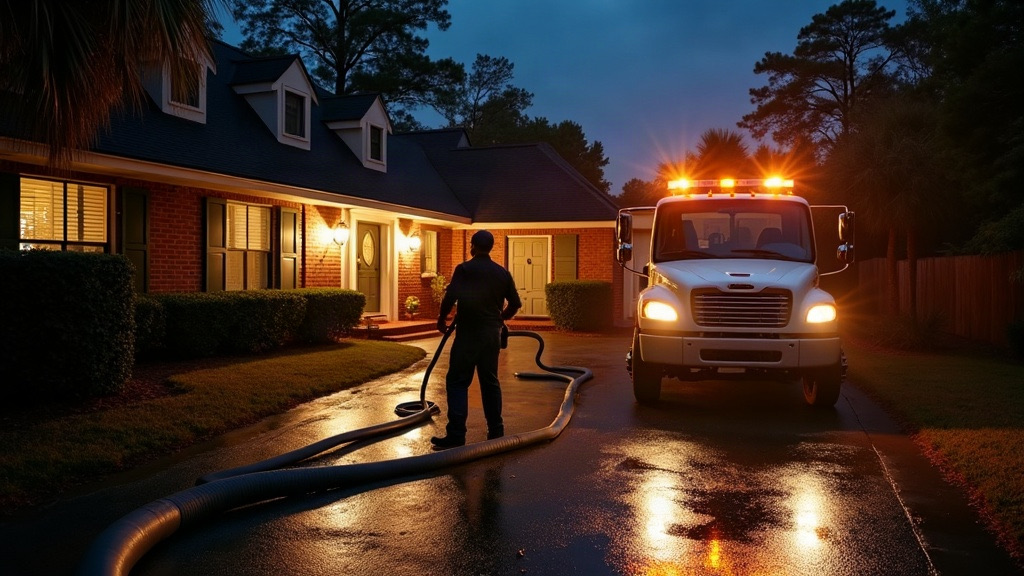
Forget the mop for a second. The sequence that limits a water loss is mechanical, and it goes like this:
Every company on our Charleston comparison list advertises 24/7 emergency dispatch — that's table stakes in this trade. The differences that matter at 2 a.m.: who answers the phone (a live local dispatcher vs a national call center), how fast a crew actually arrives (Seaside advertises a two-hour average arrival and live local dispatch; RestoPros and Paul Davis advertise same-day and 30-minute-callback targets), and whether after-hours costs extra (some charge premiums; several Charleston firms advertise no after-hours fees — ask when you call).
After named storms, every line in the metro jams at once. Two tactics that work: call two companies and take whichever dispatches first, and get on a schedule even if the crew can't come until morning — mitigation slots fill within hours of a major rain or king-tide flooding event.
Assessment first. A lead tech maps the loss with moisture meters and often thermal imaging, classifies the water (clean, gray, or black — this drives everything that follows), and walks you through the scope before equipment comes in.
Extraction. Truck-mounted extractors pull standing water far faster than any shop vac — the good ones remove the bulk of moisture from carpet and pad without pulling them up.
Demo where needed. Baseboards off, drywall flood-cut above the waterline if it's Category 2–3, unsalvageable insulation and flooring out. On clean-water losses caught early, much of this can be skipped.
Drying. Air movers and dehumidifiers run 3–5 days with daily moisture readings — the crew should show you the numbers trending down. Charleston's humidity means dehumidification does the heavy lifting; open windows are not a drying strategy here.
Antimicrobial treatment on any gray or black water contact, and a final moisture verification before equipment pulls out.
The metro's emergency calls come in three distinct waves. Plumbing failures — supply lines, water heaters, washing machine hoses, and the rare winter cold snap that freezes exposed pipes — arrive year-round, one house at a time. Storm and king-tide flooding arrives by the neighborhood: an afternoon thunderstorm parks over the peninsula, or a perigean tide pushes salt water into downtown streets and ground floors without a drop of rain. Hurricane season (June–November) is the metro-wide event: Hugo in 1989 remains the benchmark, Irma in 2017 flooded downtown with a record tide, and every season since has sent water into low-lying homes from West Ashley to the barrier islands.
The point: Charleston emergency crews work all three, and the company you want on the phone is the one that treats your Tuesday-night water heater the same way it treats a named storm — because to your floor, there is no difference.
Extraction plus a standard 3–5 day dry-out in Charleston runs $1,200–$5,000 for a typical residential loss; sewage or storm-surge contamination pushes it to $5,000–$15,000+ because porous materials come out instead of drying in place. Full tables and drivers are on our Charleston cost page. One honest caveat: in a genuine emergency you will not have time to collect three bids before mitigation starts — nor should you wait. Get the written mitigation scope before signing, keep every photo, and take your time on the rebuild contract instead.
Most Charleston-area companies quote 1–2 hours for emergency dispatch in normal conditions; Seaside advertises a two-hour average. After major storms or king-tide events, metro-wide demand pushes waits to many hours — call early and get on the schedule.
The restoration company. Policies require you to mitigate further damage, and every hour of standing water increases the loss. Call your insurer right after the crew is dispatched — with photos already taken.
Yes, a slow-motion one. It won't electrocute anyone tonight, but in Charleston's climate it feeds mold into the living space within days and damages floor systems within weeks. Treat it with the same urgency as water you can see — see our crawl space flooding page.
Some companies charge after-hours premiums; several Charleston firms advertise no after-hours fees. Ask explicitly when you call — the answer takes ten seconds and belongs in the written scope.
Usually yes for clean-water losses — expect noise (air movers are loud) and heat from dehumidifiers. Sewage losses, heavy demolition, or mold involvement may make part of the home unusable for a few days.
Speak with a local specialist 24/7 — we'll connect you with Charleston-area restoration help. Free, no obligation.