Independent directory — we compare Charleston water damage companies; we don't do the work ourselves.
Homeowner guide · Updated September 2026
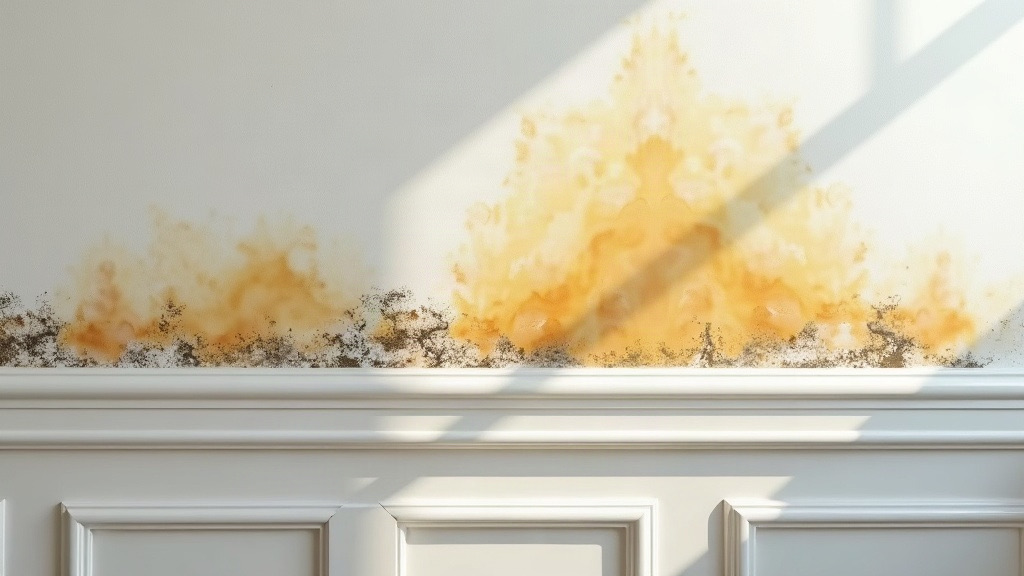
Water damage rarely announces itself with a dramatic puddle. The early tells are subtler, and in Charleston's humid air they're easy to mistake for "just the climate." The reliable ones: yellow-brown staining that blooms on drywall or ceiling paint, often with a darker edge; paint that bubbles or peels in a localized patch; drywall that feels soft or looks swollen along the baseboard line; and a musty smell in one room or one corner that cleaning doesn't fix.
On ceilings — a common search for good reason, since Charleston's afternoon storms test every roof — look for rings or spreading stains, sagging sections, and nail pops appearing along a seam. A ceiling stain that grows after each rain is an active leak, and the water entering at the stain is rarely the water entering the roof: it travels along decking and joists before it shows itself, sometimes rooms away.
The test that separates old damage from active damage is simple: touch it. Dry, hard staining with crisp edges is history. Cool, soft, or damp material — or a stain with a dark, wet-looking margin — is happening now. Moisture meters settle arguments for about $30 at a hardware store, and any restoration company will meter your walls free during an assessment.
Cupping hardwood floors. Boards that crown or cup — edges higher than centers — are absorbing moisture from below. In a crawl-space home, that's often the first visible sign of a wet crawl space, and it shows up weeks before anyone looks under the house.
Musty air when the HVAC starts. The stack effect pulls crawl-space and wall-cavity air into living space. A burst of musty smell at system start-up points at growth under the house or in the air handler.
Rust on HVAC equipment or water heater in the garage, corroded supply valves, and green or white crust on copper fittings — slow leaks that haven't become floods yet.
Tide lines on ground-floor walls or garage slabs after king tides or heavy rain — even if the water receded the same day, the materials it touched absorbed it.
If water is active: stop the source (main shut-off for plumbing), kill power to wet areas from a dry panel, photograph everything, and call a 24/7 restoration company — drying within hours is what separates a $2,000 dry-out from a $6,000 mold job. Our emergency page has the full first-30-minutes checklist.
If the damage is old or slow: resist the urge to just paint over it. Find the source first — supply line, drain, roof, window flashing, crawl space — because staining you cover without fixing the source comes back, bigger. A moisture meter reading, a flashlight trip to the crawl-space access, and one professional assessment will tell you whether you're looking at a $200 plumbing repair or a project.
Either way: document before you disturb. Photos of the source, the spread, and damaged belongings are the backbone of any insurance claim.
Charleston floods on a schedule other cities don't have. Hurricane season runs June through November — Hugo in 1989 redefined the building code here, and Irma in 2017 pushed a near-record tide into downtown. But the water most Charleston homes meet isn't from named storms: it's from king tides (perigean high tides that flood peninsula streets several times a year with no rain at all) and from slow-moving summer thunderstorms that overwhelm drainage in hours.
Large parts of the metro sit in FEMA flood zones AE and VE — the high-risk designations where flood insurance is required with a federally-backed mortgage. Zone AE covers broad low-lying areas from West Ashley to Mount Pleasant; VE (coastal high-hazard, wave action) fronts the beaches and harbor. Even Zone X ("minimal risk") homes flood here — a large share of Charleston's tidal flooding claims come from outside the high-risk lines. Your zone is searchable free at FEMA's Flood Map Service Center (msc.fema.gov) by address.
The homeowner takeaway: in Charleston, "my house has never flooded" is a statement about the past tense only. Know your zone, keep gutters and yard drainage working, know where your main shut-off is, and decide about flood insurance before June, not during a cone-of-uncertainty week.
The single most important fact: homeowners insurance covers sudden, accidental water damage from inside the house — burst pipes, failed water heaters, appliance lines — and excludes flood, which is rising water from outside. Flood requires a separate policy, through the National Flood Insurance Program or a private flood insurer, and NFIP policies carry a 30-day waiting period, so you cannot buy one when a storm is already named.
Three more things Charleston homeowners learn the hard way. First, sewer backup needs its own endorsement on most policies — cheap, and worth it with tidal drainage (see our sewage cleanup page). Second, mold coverage is usually sub-limited ($5,000–$10,000 is common) and applies only when the mold follows a covered water event reported promptly. Third, your policy requires you to mitigate — you are expected to stop the water and start drying to prevent further damage, and reasonable mitigation costs are typically reimbursable. Waiting days for an adjuster while drywall wicks water is not caution; it's how covered losses turn into denied mold claims.
Document everything, call your insurer early, keep every receipt from the mitigation crew — and remember that you choose the restoration contractor. A preferred-vendor list is a suggestion, not a requirement.
The cheap work that prevents most Charleston water losses: know and test your main water shut-off; replace rubber washing-machine hoses with braided stainless; clean gutters and extend downspouts away from the foundation before summer storm season; service the HVAC condensate line (a clogged July drain line is a classic ceiling-stain source); look under sinks and behind toilets twice a year; and once a year — ideally in May, before hurricane season — open the crawl-space hatch with a flashlight and look for standing water, fallen insulation and a torn vapor barrier.
If you're already past prevention: start with our comparison of Charleston water damage restoration companies and the cost guide, and get two written scopes before signing anything beyond emergency mitigation.
Yellow-brown staining with a darker edge, paint bubbling or peeling in a localized patch, drywall that feels soft or looks swollen along the baseboard line, and a musty smell in one room that cleaning doesn't fix. The touch test separates active damage from history: cool, soft or damp material means water is present now.
If the leak is fixed, the ceiling repair itself — cutting out stained drywall, patching, texture and paint — typically runs a few hundred dollars per room as a handyman-scope job. The expensive part is everything above the ceiling: finding and fixing the source (roof, flashing, HVAC condensate line) and drying wet insulation and joists before mold sets in. A restoration company will meter the cavity free during an assessment; that reading decides whether you need a painter or a drying crew.
No — dry, hard staining with crisp edges is usually an old, already-fixed event. A stain that grows after each rain, feels cool or damp, or has a dark wet-looking margin is active. In Charleston, a ceiling stain that blooms after afternoon storms points at the roof or flashing; one that grows regardless of weather points at plumbing or an HVAC condensate line.
It always means moisture, and in Charleston's humidity moisture and mold are rarely far apart. A musty burst when the HVAC starts often points under the house — the stack effect pulls crawl-space air up into living space. A $30 moisture meter and a flashlight trip to the crawl-space hatch will tell you more than any amount of sniffing.
Extraction happens on day one; structural drying typically runs 3–5 days with daily moisture checks. Rebuild work — drywall, flooring, trim — adds days to weeks depending on scope. A sewage loss or a flooded crawl space adds time for demolition, sanitizing and clearance checks.
Look up your address free at FEMA's Flood Map Service Center (msc.fema.gov). Much of the metro sits in high-risk AE and VE zones where lenders require flood insurance — but a large share of Charleston's tidal flooding claims come from Zone X ("minimal risk") homes, so the zone line is not a safety guarantee.
Speak with a local specialist 24/7 — we'll connect you with Charleston-area restoration help. Free, no obligation.