Independent directory — we compare Charleston water damage companies; we don't do the work ourselves.
Quick answer
Most residential mold remediation jobs in Charleston run $1,500–$6,000 (national cost data), with contained single-area jobs at $1,500–$3,000 and multi-room or HVAC-involved contamination at $4,000–$8,000+. Legitimate remediation follows the IICRC S520 standard: independent assessment, containment, HEPA filtration, removal of contaminated material, and — the part that actually fixes it — correcting the moisture source. Companies serving Charleston with mold on their published service list include Seaside Restoration, RestoPros, PuroClean, Paul Davis and Disaster Plus.
Price ranges are compiled from national cost guides, September 2026. Final pricing always follows an on-site inspection — any firm quoting mold work sight-unseen is guessing.
Tell us what happened — we'll connect you with Charleston-area restoration help right away. Free, no obligation.
Call (803) 910-601824/7 — speak with a local specialist now.
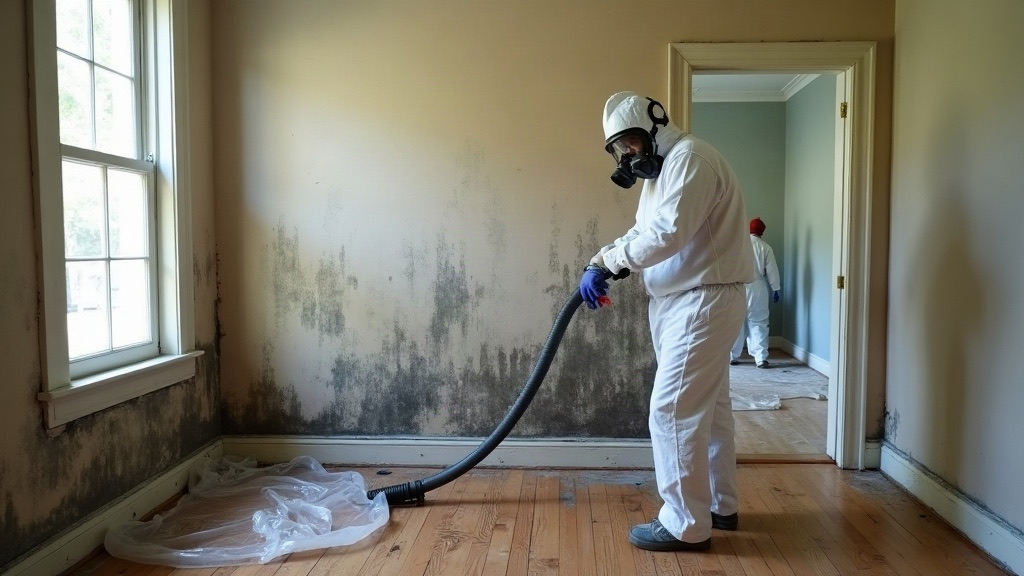
Mold needs three things: a food source (drywall paper, wood, dust), the right temperature, and moisture. Charleston supplies all three generously. Relative humidity sits high most of the year, the water table is shallow, king tides and summer storms push water into crawl spaces and ground floors, and many homes — especially on the peninsula and in older West Ashley and James Island neighborhoods — were built decades before modern vapor-barrier standards.
The practical consequence: in Charleston, mold rarely appears out of nowhere. It follows a moisture event — a slow plumbing leak, a roof that took on water during a tropical storm, a crawl space that floods twice a year, an HVAC condensate line that clogged in July. That's why remediation that doesn't fix the moisture source is money spent on a problem that will be back in six months.
A legitimate job follows the IICRC S520 standard, and the sequence is consistent across reputable Charleston companies:
Mold remediation is listed among the services of most full-service restoration firms in the metro — locals like Seaside Restoration, Disaster Plus and Patriot Restoration, and franchise teams like RestoPros of Charleston, PuroClean, Paul Davis and SERVPRO.
See our side-by-side comparison of Charleston restoration companies for phones and service areas, or the full verified list. For a pure mold job, ask each bidder who performs their testing — a company that grades its own homework is a conflict of interest worth avoiding.
If Charleston has a mold capital, it's the vented crawl space. Most metro homes sit over one, the soil is sandy Lowcountry with a high water table, and warm humid air moving through foundation vents condenses on cooler surfaces under the house. Add one plumbing leak or one flooded yard, and the crawl space becomes an incubator that vents straight into the living space above — stack effect pulls crawl-space air up through the house.
Signs the problem is under your house rather than in it: musty smell strongest at floor level or when the HVAC kicks on, cupping hardwood floors, and allergy symptoms that ease when you leave home. The fix is usually two-staged: remediate the growth, then encapsulate or at minimum re-lay a proper vapor barrier. Companies that do water damage but won't crawl under your house are not the right call for this job — our crawl space flooding page covers that scope in detail.
National cost data puts a contained, single-area job — a bathroom, a closet, one wall — at $1,500–$3,000. Multi-room contamination or mold inside HVAC systems runs $4,000–$8,000+. Crawl-space remediation with vapor barrier replacement typically adds $1,500–$5,000 depending on square footage and whether drainage work is needed. Full numbers and drivers: mold remediation cost in Charleston.
Most residential jobs run $1,500–$6,000 based on national cost data: $1,500–$3,000 for a contained single area, $4,000–$8,000+ for multi-room or HVAC-involved contamination. Crawl-space work adds $1,500–$5,000. Always get the moisture source scoped in the same quote.
For a few square inches on a non-porous surface (tile, tub), household cleaner is fine. Bleach does not reliably kill mold in porous materials like drywall and wood — the water in it can actually feed regrowth — and disturbing an established colony without containment spreads spores through the house. EPA guidance puts the DIY cutoff at roughly 10 square feet; Charleston crawl-space and post-flood jobs are almost never DIY-scale.
Sometimes. Mold that results from a covered sudden water event (a burst pipe) is often covered up to a mold sub-limit — commonly $5,000–$10,000. Mold from long-term humidity, deferred maintenance or flooding is typically excluded. Document the water event and report it promptly; delays are what turn covered mold into excluded mold.
A contained single-area job is usually 1–3 days. Multi-room or crawl-space projects run 1–2 weeks including drying and clearance testing. Add time if the moisture source needs plumbing or drainage repair first.
Not always. If mold is visible and the moisture source is obvious, reputable firms remediate without lab work. Testing earns its cost when growth is hidden, when health symptoms are driving the job, or when you need independent clearance documentation for a sale or an insurance claim.
Only if the moisture source survives. Remediation removes growth; it cannot remove Charleston's humidity. Jobs that include source correction — leak repair, encapsulation, dehumidification — stay fixed. Jobs that don't, come back.
Speak with a local specialist 24/7 — we'll connect you with Charleston-area restoration help. Free, no obligation.